
Wednesday | June 29th
September 10, 2011 by admin
Filed under InnerSea Discoveries
Patterson Bay: Scat and Cataracts!
Wake up to the sound of heavy rain and the euphonious waterfalls that surround our anchored vessel.
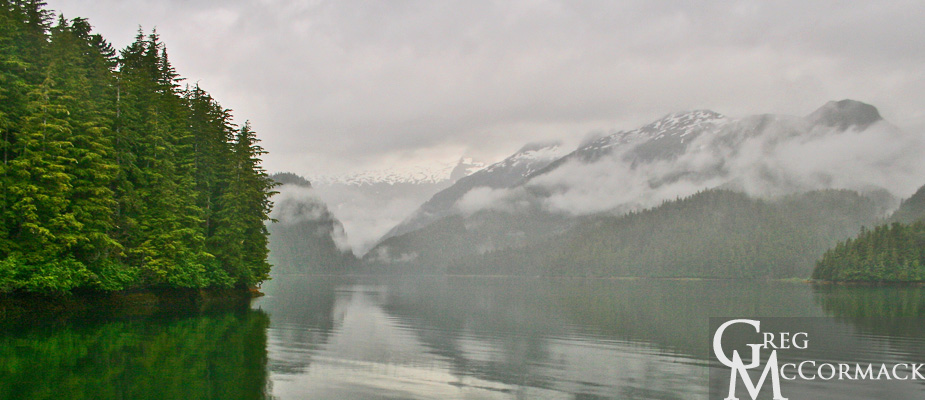
As you might say in Spanish: Que lastima! Esta lloviendo (what a pity that it’s raining). But here’s my saying for the day: “Whether the weather is wet or whether the weather is dry…whatever the weather we’ll weather the weather, whether we like it or not.” I should add: “There is no such thing as bad weather…there is only inappropriate gear.”
It’s easy to think that the inclement weather will continue for days, if not weeks, since there isn’t any sign of a “blue-hole” or patch of blue in the sky. Positive thinking really helps and it’s encouraging to see gung-ho guests ready to get out and brave the elements. We all know, of course, that “liquid sunshine” is what makes the temperate rainforest so lush and verdant! If we get a bit cold, we can all get in the hot tubs after our days adventures!
Today I lead two separate groups through dense vegetation to a well-hidden and spectacular waterfall.
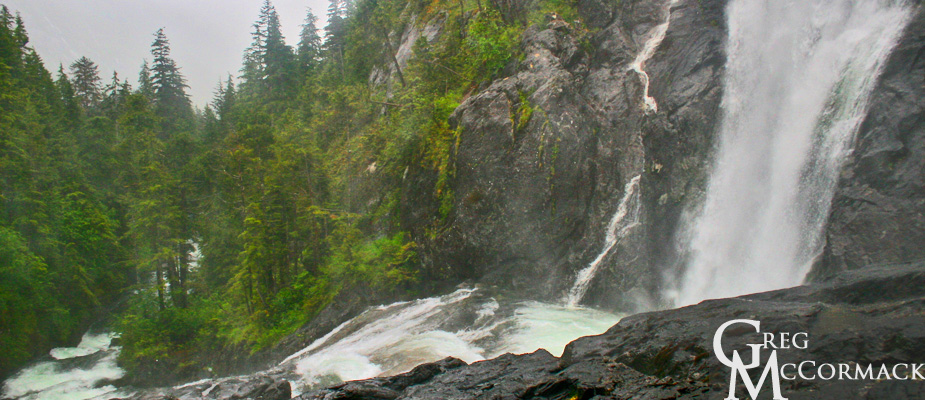
I have to yell “HEY BEAR” while pushing through the tall salmonberry shrubs, alder thickets and Devils’ Club plants to alert any sleeping grizzly bears. The guests follow me as I crawl under and on top of giant, fallen trees. We are sopping wet within 100 yards of penetration but all have big grins on their faces. Why? Because this is as good as it gets for pure wilderness! After we step over our first of at least 10 large piles of brown bear scat, I pronounce: “Welcome to the food chain!”
In the lower 48 States (or anyplace in the world for that matter), it’s easy to take trails for granted. It isn’t until we get into the path-less woods that we can appreciate all the effort it takes to build and maintain a trail. Four legged mammals have the advantage of ducking under massive fallen trees while looking for the least difficult way through an ecosystem to find food, water and shelter.
I shoot some video of our hiking group pushing through the wet vegetation and into the shallow river where it is easier to navigate.
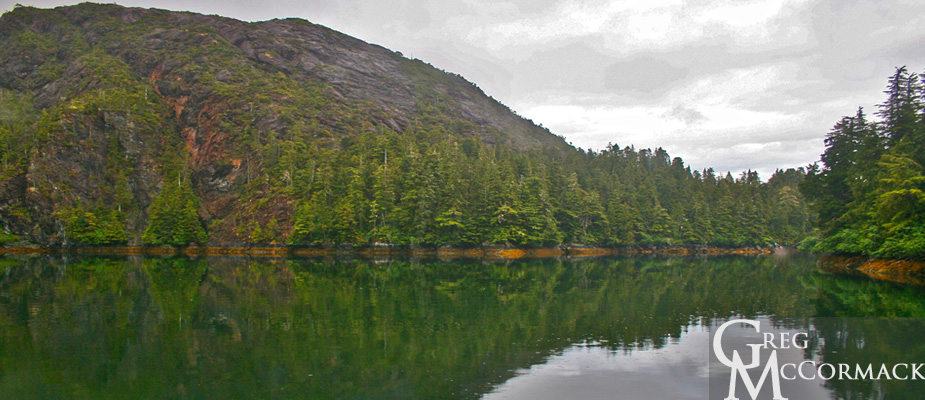
In the late afternoon, our captain decides to motor into another of the spectacular fiords on the southeast side of Baranof.
The scenery is mesmerizing at just a few knots per hour and many are quiet and contemplative on our journey up to a waterfall and a view of a brown bear.
Tuesday | June 28th
September 9, 2011 by admin
Filed under InnerSea Discoveries
Last night some were worried about a potential rough crossing to arrive at South Baranof across Chatham Strait. Some folks complained of being sea-sick while others enjoyed the rocking and rolling that lulled them to sleep in the berths of their cabins.
Several activities are offered to our guests. I enjoy being the all-day kayak guide.
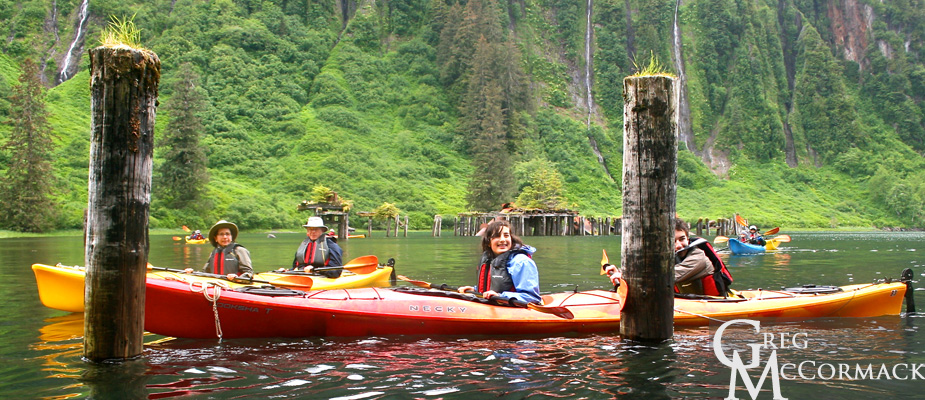
We enjoy a paddle along the south side of the fiord to an old herring rendering plant.
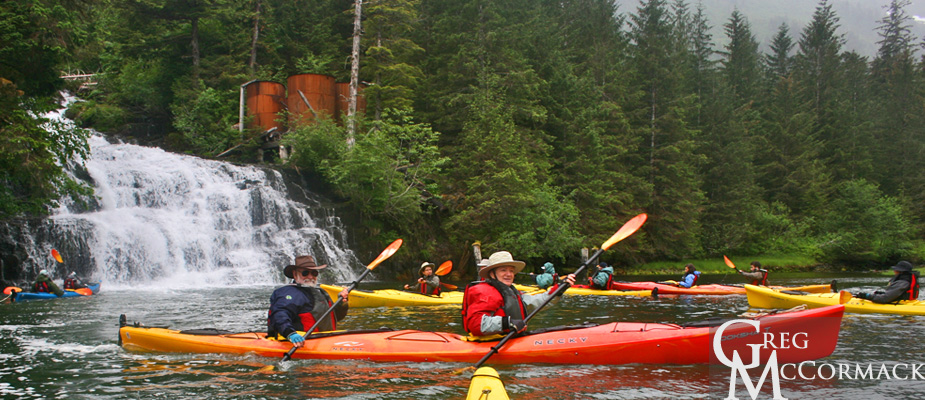
Stop to play at a waterfall located adjacent to some old rusty tanks.
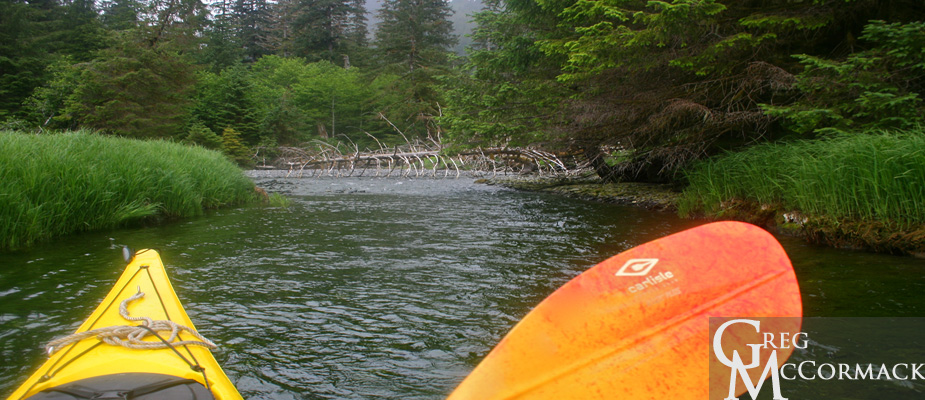
We continue to a place named “Lovers Cove” and are able to paddle up a magnificent little river that has “perfect salmon spawning habitat” written all over it. A large, fallen snag stands with branches akimbo across the riffle area where we have to turn-around.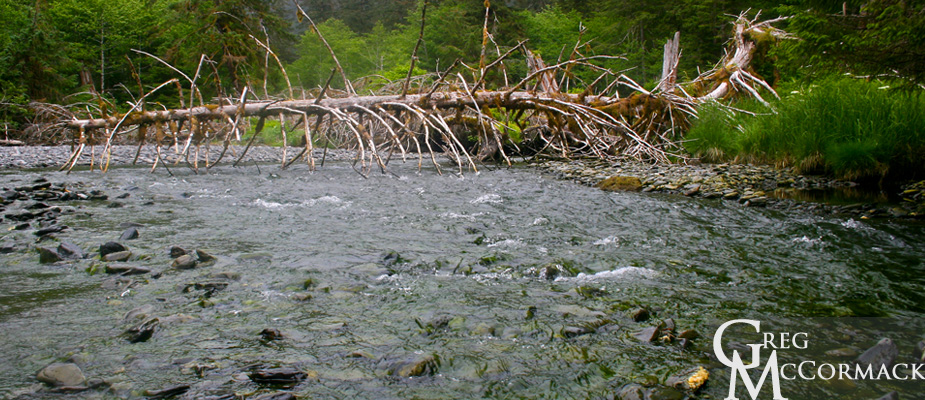
Later, the strongest of the paddlers continue to another inlet that houses the Little Port Walter station of the National Oceanic and Atmospheric Administration. When we arrive to the dock, I noticed what I thought was a funny-looking sea otter swimming from where we had just paddled. A fish biologist, who has a better view, tells us the swimming mammal is a bear. We immediately turn around as quickly as we could and enjoy watching it shake the excess water off of its back before disappearing into the forest.
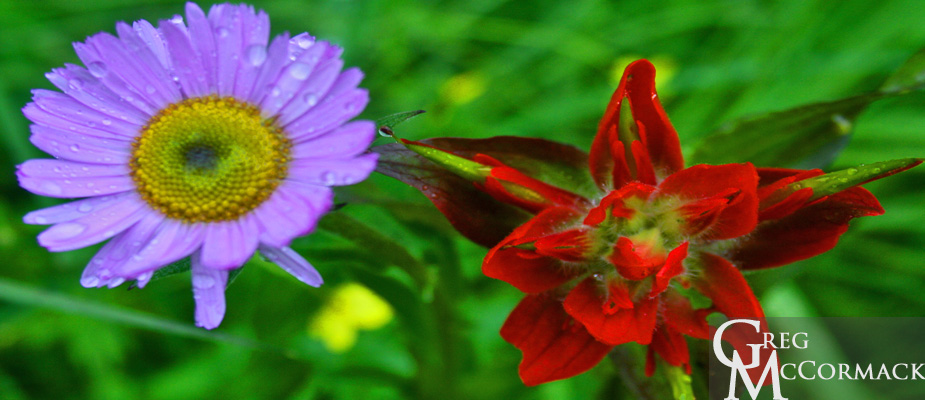
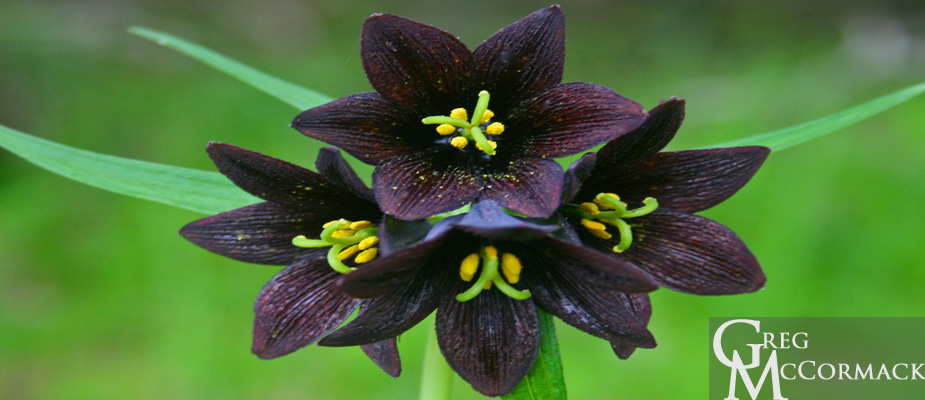
On the opposite shore we make a micturition stop with an opportunity to stretch our legs. We spot some pretty wildflowers, including daisy, paintbrush and chocolate lily.
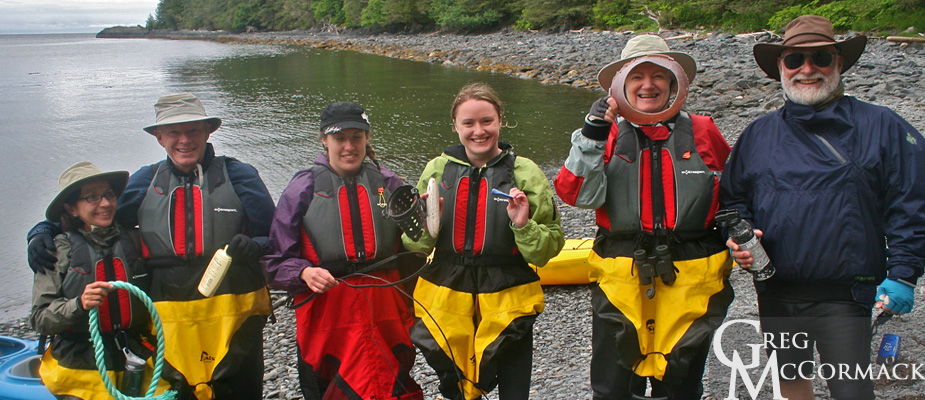
We each carry-out a few marine debris items that were strewn up in the beach wrack zone. I take a group photo of everyone holding their most interesting finds, including a hagfish trap, oyster spacers for aquaculture, plastic bottles and a small fish net. I take the opportunity to describe the issues surrounding marine debris and derelict fishing gear and the impacts on marine wildlife.
Back aboard the M/V Wilderness Discoverer, the youngsters enjoy a simulated “campfire” adjacent to a pitched tent in the lounge. The kids ensconced themselves on the pads and wrapped themselves up in the sleeping bags and ate bags of microwaved popcorn.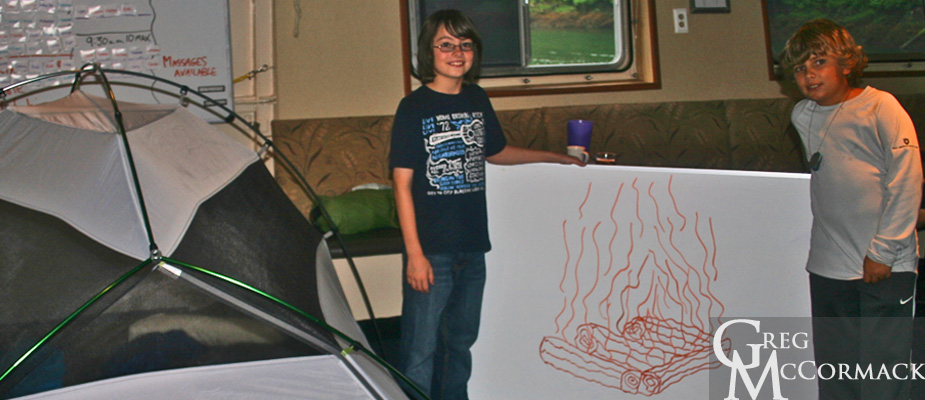
Monday | June 27th
September 9, 2011 by admin
Filed under InnerSea Discoveries
Klawock and Sea Otter Sound
We enjoy sunny skies as we disembark at the docks in Klawock and assemble on the pier for a walking tour. Les our guide tells stories his father told him about signs being put out in the streets that said: “No Dogs or Indians Allowed”. He went on to describe the beginning of the Alaska Native Brotherhood.
I drift into reverie and can’t help but think of the audacity of the first Europeans when they arrived in North America by asking the natives: “Where is your flag? You don’t have one? We claim this land for the Queen of England!”
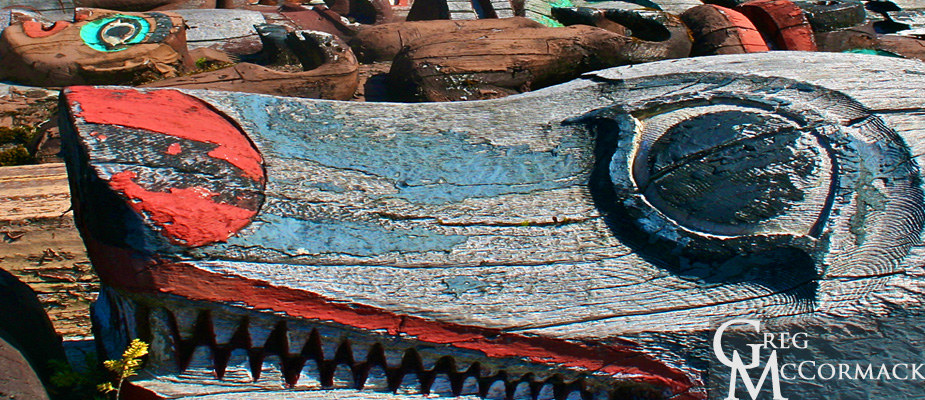
We approach the oldest cannery in Southeast Alaska and Les tells us about how thick the fish returns used to be. Behind the cannery about 2 miles away we can see a large paper/pulp mill. Les tells us that countless logs are shipped overseas from Prince of Wales Island to the Far East. Apparently, the mill is owned by the same family that runs the mill in my home-state of Washington at Port Townsend. 30 employees are employed at the POW site near Klawock.
For the birders in the group, we are entertained by the behavior and vocalizations of around two dozens species, the loudest of which is the song sparrow, orange-crowned warblers, winter wren and common raven. The call of the bald eagle “wowed” some folks. Film-makers in Hollywood seem to always play a recording of a red-shouldered hawk in place of the real eagle vocalization. Perhaps the real eagle call is un-regal?
The view of the river estuary with the backdrop of the snow-capped mountains was appreciated by all as we walked a mile to the carving shed from the totem park.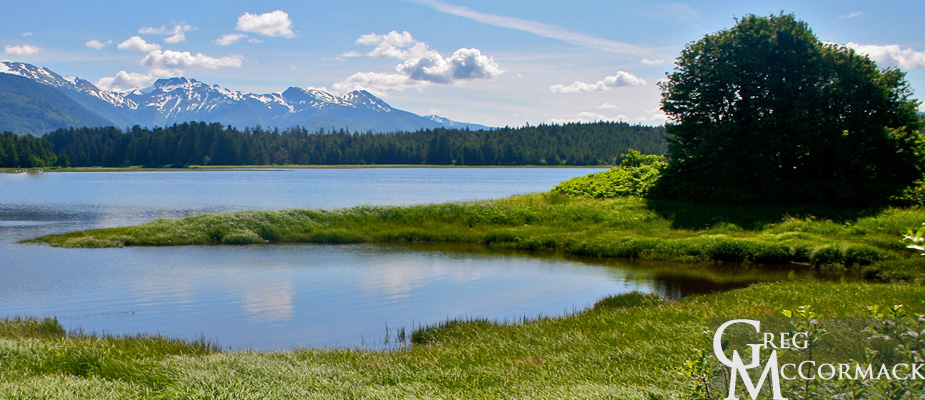
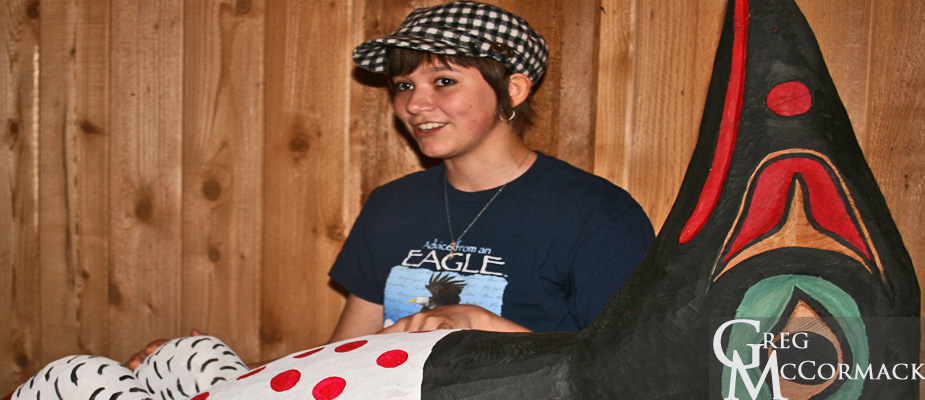
For those of us crew that make it here twice per month, we were amazed at how much progress has been made on the totems that will be erected in early August during a three-day festival. Accompanying Les is young apprentice James Mills, who has contributed his advanced carving skills to the community of Klawock. Everyone enjoys the carving shed where we meet Master Carver Jon Rowan Jr., the main carver of poles and overseer of the project. Sydney, niece of Les, has done a marvelous job of painting the totems, particularly the Naasteidi Flicker totem pole that has the red polka dots.
We get back underway at lunchtime and enjoy a mid-afternoon party on the Sun Deck. The central focus is our over-sized BBQ grill. Passengers and crew crowd around where we shuck and roast oysters that we picked-up yesterday from our oyster-farming friends in El Capitan Passage.
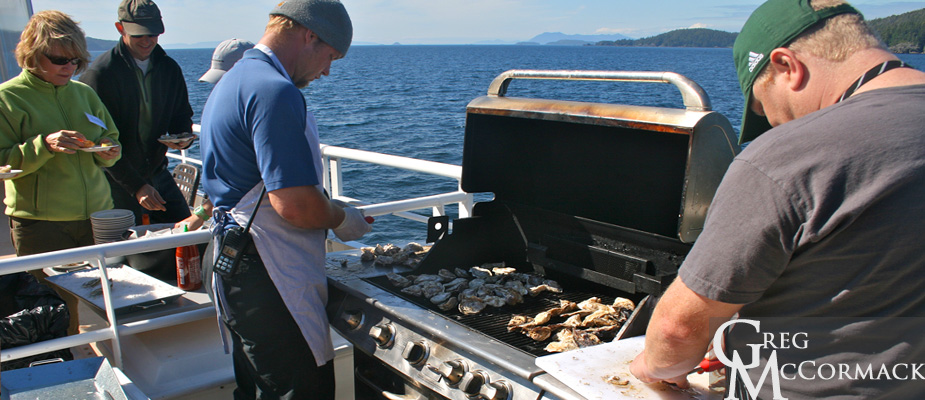
Captain Dano Quinn is busy on the bridge watching for whales but he enjoys the flavors of our shellfish with hot sauce!
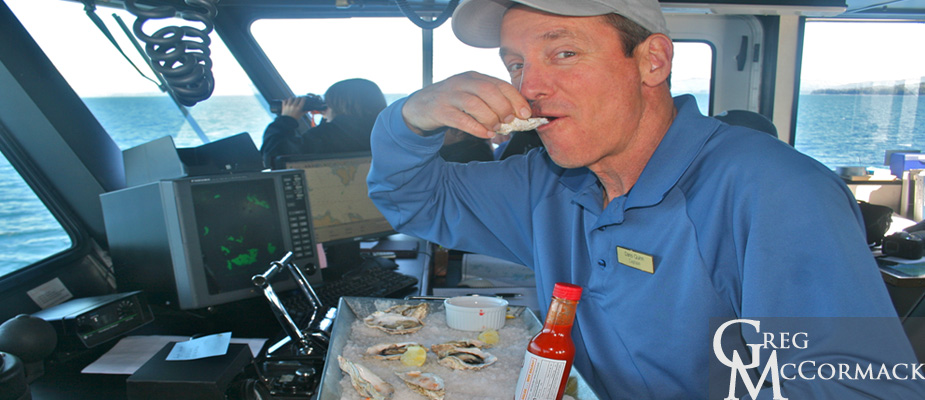
Captain Dano surprises us later in the afternoon with an offering of small boat tours to a miniature archipelago of islands in Sea Otter Sound. The lighting for sunset is warm and perfect for pictures. As usual, a parade of interesting plankton flowed beneath the ship, including jellyfish and a pelagic mollusk.

Sunday | June 26th
September 9, 2011 by admin
Filed under InnerSea Discoveries
El Capitan Passage, Caves and Oyster Pick-up
I lead a couple of groups along the U.S. Forest Service trail to the caves. This is a great area to explain the hallmarks of a temperate rainforest, such as the presence of Sitka spruce, nurse logs, a profusion of mosses and ephiphytes, among others. We look at signs of a second growth forest such as trees of the same age and height class that grow so thick that sunlight cannot penetrate the canopy to reach the forest floor. The lack of sunlight leads to a paucity of herbaceous and shrubby plants that provide habitat or browse for herbivores such as deer.
It is obvious when we make the transition into an old growth forest. We notice lots of shrubs such as the false azalea, blueberry, and devils club along with ferns and their allies. Trees are of different age and height classes leading to a multi-layered canopy. Some of the trees are too large to hug with a diameter-at-breast-height or DBH of 30-inches. Nurse logs and snags are abundant, on the order of dozens per acre.
Old growth forests of several hundred years or more have a certain spacing between trees, perhaps 20 feet between each large tree, encompassing up to 400-600 trees per acre. In comparison, a second-growth forest will have several thousand trees per acre. Spacing is mere inches or only a few feet between each tree, leading to the lack of understory and little habitat for forest-dwellers. 95% of the forests in the lower-48 have been cut.
During the decades of the 60’s to 90’s, foresters bragged about more trees growing in America than at any point in our history. That is a true statement, but what is not mentioned is that the Department of Agriculture manages trees like crops and often have a mono-culture of single-species plots, leading to a much less bio-diverse ecosystem. Species such as the marbled murrelet and spotted owl were listed as threatened or endangered of extinction. Court injunctions followed and tough times for loggers because the industry saw it cheaper to ship raw logs and jobs overseas. Management strategies and forestry practices have changed for the better…
I spot a family of woodpeckers nesting in a large snag. The sapsuckers were busy flying to and fro to feed the noisy young inside of the tree. The sallying forth for arthropods such as flies and moths was entertaining as we rested to catch our breath about half-way up the 367 stairs.
At the El Capitan Caves, we are greeted by two National Forest Service rangers.
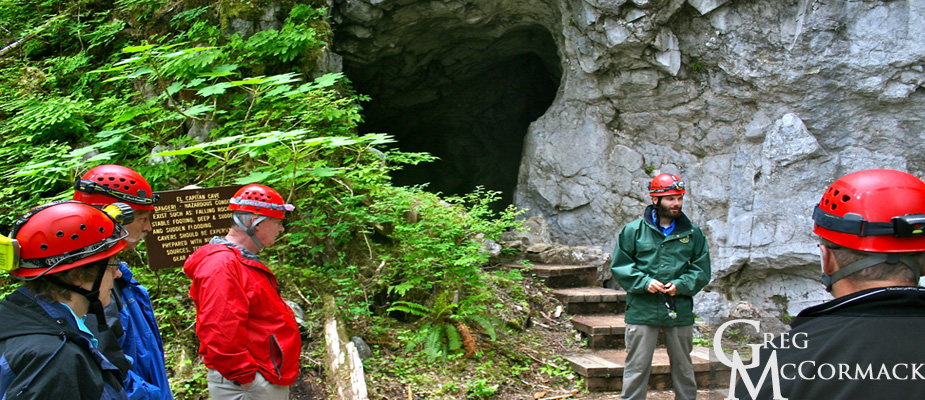
We learn about speleothems or stalactites and stalagmites and how they are formed. A graphic was passed around with the chemical equation for the process: Ca2 + 2HCO3 CO2 + CaCO3 + H2O.
A popular shot for photographers is the sign at the entrance to the caves. It reads: “EL CAPITAN CAVE. Danger! Hazardous conditions exist such as falling rocks, unstable footing, deep and sudden pits and sudden flooding. Cavers should be experienced and prepared with numerous light sources, technical climbing gear and survival gear.”

Our National Forest Service guides pass around some interesting photographs HERE
Saturday | June 25th
September 9, 2011 by admin
Filed under InnerSea Discoveries
We lift anchor at 0600 and motor a few nautical miles to Ketchikan for disembarkation at 0830. We bid a fond farewell to our old friends and shipmates. It has been a week-long voyage but when we recollect all of the memories, it seems as if we were together for a much longer period of time. We have experienced so much with all of our senses.

After a long and hard push to clean the ship from top to bottom, we wait for our new passenger friends and shipmates to board the M/V Wilderness Discoverer at 1630 hours.
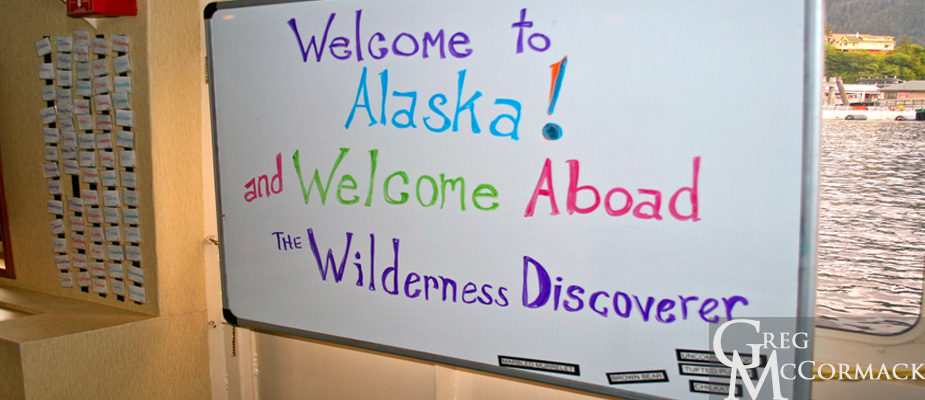
All of us take turns to show guests to their cabins. We meet folks in the lounge for appetizers and “welcome aboard” drinks.
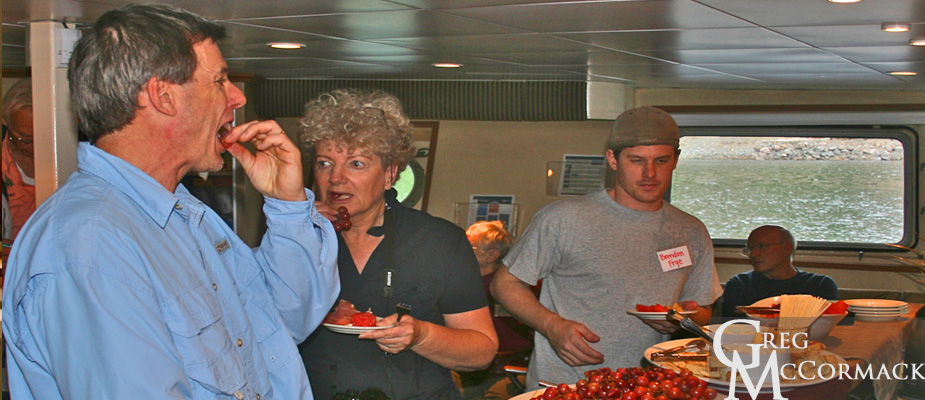
The captain, expedition leader, chief engineer and hotel manager each give a brief introduction to ship-living. We are on our way north up and around Prince of Wales Island.
This evening several of our guest passengers assemble in the lounge and play music. Friends are made rapidly and much merriment ensues.There are suggestions that our company buy some instruments for the vessels night entertainment, such as a Latin percussion box drum and a mid-level guitar, such as a Yamaha or “Ibanez”. Why not add tambourines, shakers with rice, recorders, etc?

Too much fun at night might lead to some weary adventure-seekers during the daytime, so let’s get some rest!